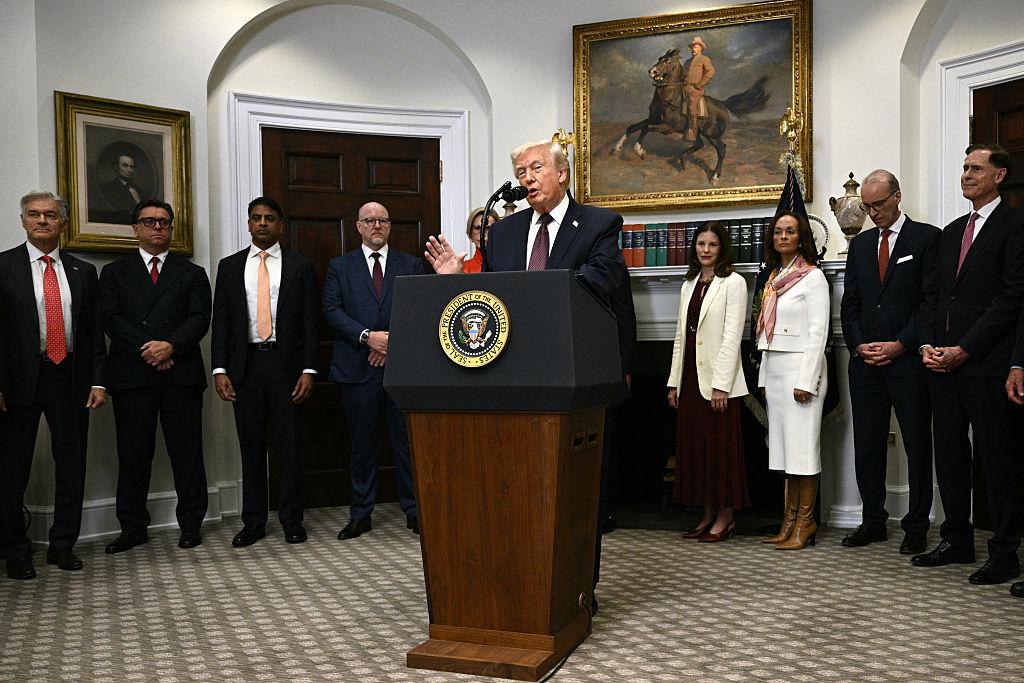
President Donald Trump renewed his push for comprehensive digital asset legislation this week, calling on Congress to move quickly on the proposed U.S. CLARITY Act. In remarks focused on financial innovation and regulatory reform, Trump framed the bill as essential to restoring American leadership in blockchain development and modern financial infrastructure.
The CLARITY Act aims to resolve long standing jurisdictional overlap between federal regulators overseeing digital assets. For years, uncertainty surrounding whether certain tokens qualify as securities or commodities has created operational friction for exchanges, custodians, and blockchain startups. Industry participants argue that without defined standards, compliance remains reactive rather than predictable.
Trump positioned the legislation as a strategic economic priority. According to his view, prolonged ambiguity is pushing capital formation and entrepreneurial talent toward jurisdictions with clearer regulatory regimes. As the global digital asset market continues to mature, the absence of comprehensive U.S. policy risks weakening domestic competitiveness.
Regulatory Structure and Market Confidence
Supporters of the CLARITY Act believe that codified definitions and agency boundaries would unlock institutional participation. Pension funds, asset managers, and publicly traded firms have largely remained cautious in expanding digital asset exposure due to regulatory unpredictability.
Clear statutory guidance could provide defined token classifications, establish compliance pathways for trading platforms, and clarify custody requirements. For institutional investors, regulatory certainty is often a prerequisite for large scale capital allocation.
The broader policy debate has increasingly shifted from whether crypto should be regulated to how it should be regulated. Trump’s remarks reflect that evolution. Rather than dismissing digital assets, the conversation now centers on structuring oversight to balance innovation and consumer protection.
Banking Access and the Debanking Controversy
Beyond legislative reform, Trump criticized major banks for what he described as limiting services to crypto related businesses. The issue of debanking has surfaced repeatedly within the industry, with some companies reporting account closures or difficulty securing stable banking relationships.
Traditional financial institutions operate under strict federal compliance standards that include anti money laundering requirements and risk assessments. Banks argue that digital asset exposure can increase regulatory scrutiny and operational complexity. Crypto companies counter that inconsistent banking access stifles legitimate innovation.
Even decentralized platforms depend on fiat rails for payroll, vendor payments, treasury management, and customer onboarding. Limited access to traditional banking services can significantly constrain operational scalability.
Trump’s comments elevate this industry complaint into national policy debate, framing financial access as a matter of economic fairness and technological leadership.
Congress has debated stablecoin frameworks, custody standards, exchange oversight, and taxation clarity. The CLARITY Act represents one of the most comprehensive attempts to formalize federal oversight structure.
International competition adds urgency. The European Union’s Markets in Crypto Assets framework and structured licensing regimes in Asia have provided clearer compliance environments. U.S. lawmakers now face pressure to establish a similarly cohesive structure.
If enacted, the CLARITY Act could signal that the United States intends to anchor digital asset innovation domestically rather than risk continued capital migration. For institutional investors, clarity may translate into greater confidence. For entrepreneurs, it may determine whether the next wave of blockchain infrastructure is built onshore or abroad.
As digital finance increasingly intersects with national economic strategy, regulatory definition rather than enforcement ambiguity may become the defining factor in America’s competitive positioning.